
| Keyboard feature | What it means | Planning use |
|---|---|---|
| Standard piano size | 88 keys; middle C is the fourth C from the left | Count the Cs from the left end to locate middle C instead of guessing the centre. |
| Black key groups | Alternating groups of two and three | Use the groups as landmarks, because every white key sits in a recognisable spot beside them. |
| Starting note | C is the white key left of the group of two black keys | Find C first, then name the other white keys by moving right. |
| Natural note names | A, B, C, D, E, F, G | Learn seven letters, not the whole keyboard. |
| Black key names | Sharp (♯) is the black key above a named note; flat (♭) is the black key below it | Read a sharp as “up to the right” and a flat as “down to the left”. |
| E to F and B to C | Each pair is a half step apart | Expect no black key between these white-key pairs and plan fingering and scale shapes accordingly. |
These figures come from the Musicca notes guide and the flowkey note-reading guide.
Piano keys and notes follow one repeating pattern. White keys carry the seven letter names A to G, and the black keys, grouped in twos and threes, show where to start: C sits just left of the pair.
Once the pattern is clear, every other step becomes easier, from how to learn piano fast to reading a score. This guide teaches the keyboard first and leaves staff notation for later.
What the layout means when you sit down
A standard piano has 88 keys, but a beginner never needs to think about all of them at once. According to Musicca, Western music uses twelve notes: seven natural notes on the white keys and five on the black keys. The same short pattern is repeated up and down the whole keyboard, so learning one stretch teaches the rest.
That has practical consequences for how you start.
- Learn a small pattern, not 88 names. The seven natural note names repeat, so a short stretch of keys is enough to practise on first.
- Use the black keys as signposts. The white keys look identical to each other; the black key groups are what make them distinguishable at a glance, without looking down at labels.
- Think in direction. The further right a note is, the higher it sounds, and the further left, the lower. Knowing this lets you move toward a higher or lower note without counting every key.
- Postpone sticker labels. Labels can help for a short time, but the black key groups work on every piano and every keyboard, so they are the habit worth building.
The next step is to use those landmarks to find a first note.
Finding C with the black key groups
The white and black keys on a piano are not scattered at random. As Musicca explains, the black keys come in alternating groups of two and three, and the note C is always the white key to the left of a group of two black keys.
Step-by-step method for locating C
- Look along the keyboard for a pair of black keys sitting close together.
- Place a finger on the white key immediately to the left of that pair.
- Name that key C.
- Repeat on every other pair of black keys to find each C on the instrument.
Because the pairs recur along the keyboard, there are many Cs, each a different pitch. The same trick works whichever part of the keyboard you start from, so you never have to begin at the far left end.

Choosing which C to call middle C
Of all the Cs, the middlemost one is called middle C. On a standard 88-key piano, Musicca notes that middle C is the fourth C from the left. That count applies to the full-size layout. On a smaller keyboard, look for the C nearest the centre of the instrument instead.
Note names and the octave chart
The natural notes take their names from the first seven letters of the alphabet: A, B, C, D, E, F and G. Because the names start again after G, the keyboard is a loop of letters laid out from left to right.
Starting from C, the white keys read as follows.
- C: the white key left of the pair of black keys, and the anchor for everything else.
- D, E, F, G: the next white keys moving right, in alphabetical order.
- A, B: the letters continue after G, wrapping back to the start of the alphabet.
- C again: the next C to the right is the same note name at a higher pitch.
That stretch from one C to the next C is an octave. Musicca defines it as the distance from any note to the nearest lower or higher version of the same note. A useful consequence is that any octave on the keyboard looks identical, so a label learned in one place is valid everywhere.
Names alone are not the whole story, because the black keys also need names. That is where sharps and flats come in.
Sharps, flats and naturals
Every black key is named in relation to a neighbouring white key. As the flowkey guide puts it, a sharp (♯) is the black key above the named note, so C♯ is the black key above C. A flat (♭) is the black key below the named note, so B♭ is the black key below B. A natural (♮) is simply the white key with the named note, so D natural is just D.
The difference between a sharp and a flat is therefore direction. A sharp moves up to the right, and a flat moves down to the left. A black key that sits between two white keys is above the lower one and below the higher one. That means the same key can be read as the sharp of one note or the flat of its neighbour, and which name appears depends on the music you are reading.

Why some white keys have no black key between them
Musicca describes the half step as the distance from any white or black key to the key immediately to its right or left. It also notes that E and F, and B and C, are a half step apart. Since the keys are adjacent, no black key falls between those pairs. That is why the black key groups break up the white keys into recognisable clusters, and why the gaps in the pattern are useful rather than irregular.
From keyboard letters to the printed page
Learning the keyboard first gives the notation a physical meaning. When you later open a score, each printed note corresponds to a key you already know by position and name. The step-by-step guide on how to read piano sheet music picks up from here.
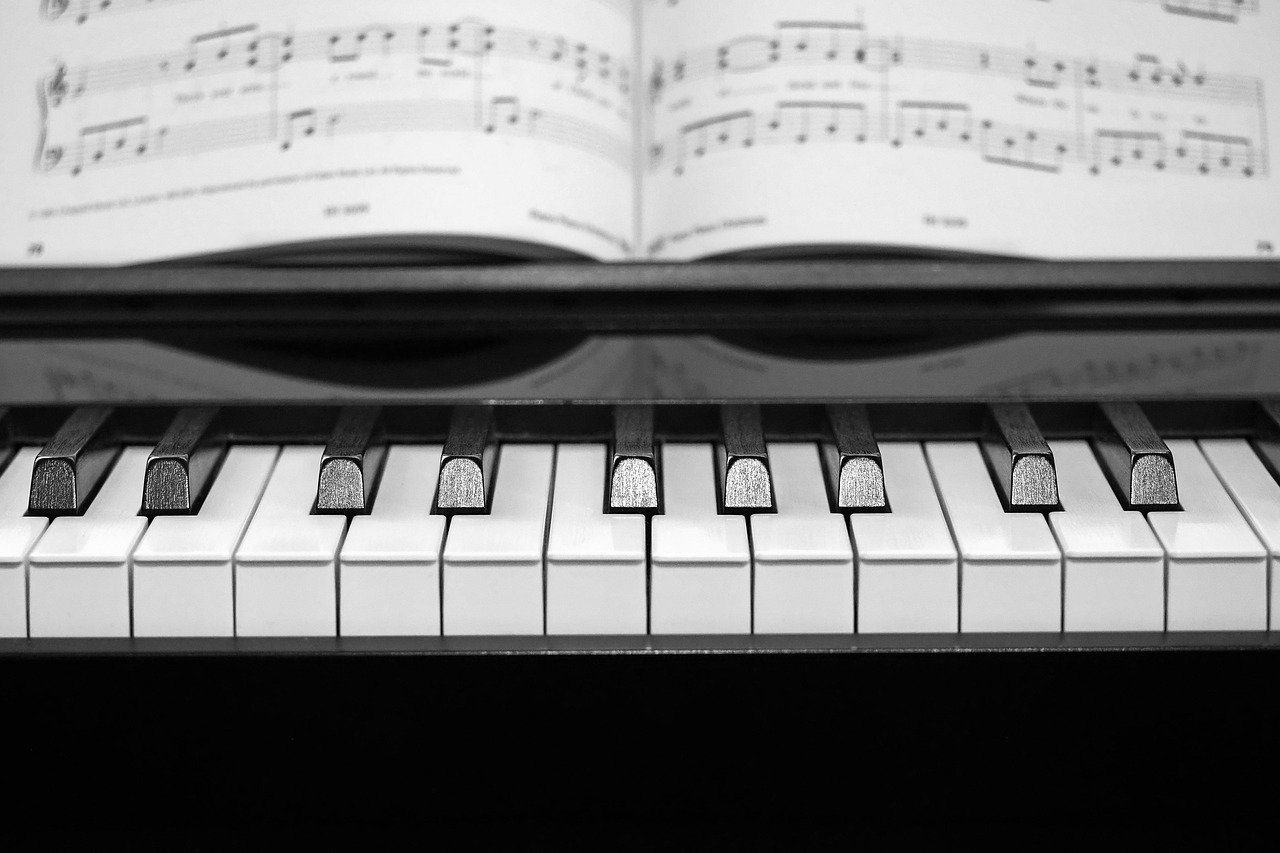
Note names and posture are separate skills, but they work together. Once you can find C quickly, it is worth setting up your arms and fingers properly, and the guide to correct piano hand position covers that side of playing.

Frequently asked questions
How many notes does Western music use?
Twelve. Seven are the natural notes on the white keys and five are on the black keys, according to Musicca.
How are octaves numbered?
Numbering starts from C. The octave of the lowest C on the piano is number 1, and the octave of the highest C is number 8.
What is the difference between a half step and a whole step?
A half step is the move to the adjacent key on either side, white or black. A whole step, also called a whole tone, equals two half steps.
Is a natural note the same as a white key?
Yes. The flowkey guide defines naturals as the white keys, each carrying the plain named note.